Northern Virginia Mortgage Decision Guide
Home › Northern Virginia Mortgage Decision Guide
Ask A Walker mortgage journey
Northern Virginia Mortgage Decision Guide
You do not need to become a mortgage expert. You need a clear way to compare the choices that affect your cash, monthly obligation, flexibility, risk, and time horizon.
 By Abraham Walker · Published August 26, 2026 · Updated August 26, 2026
- Budget
- Cash
- Program
- Term
- Rate
- Pricing
- Insurance
- Current loan
- Insurance
- Principal
- Refinance
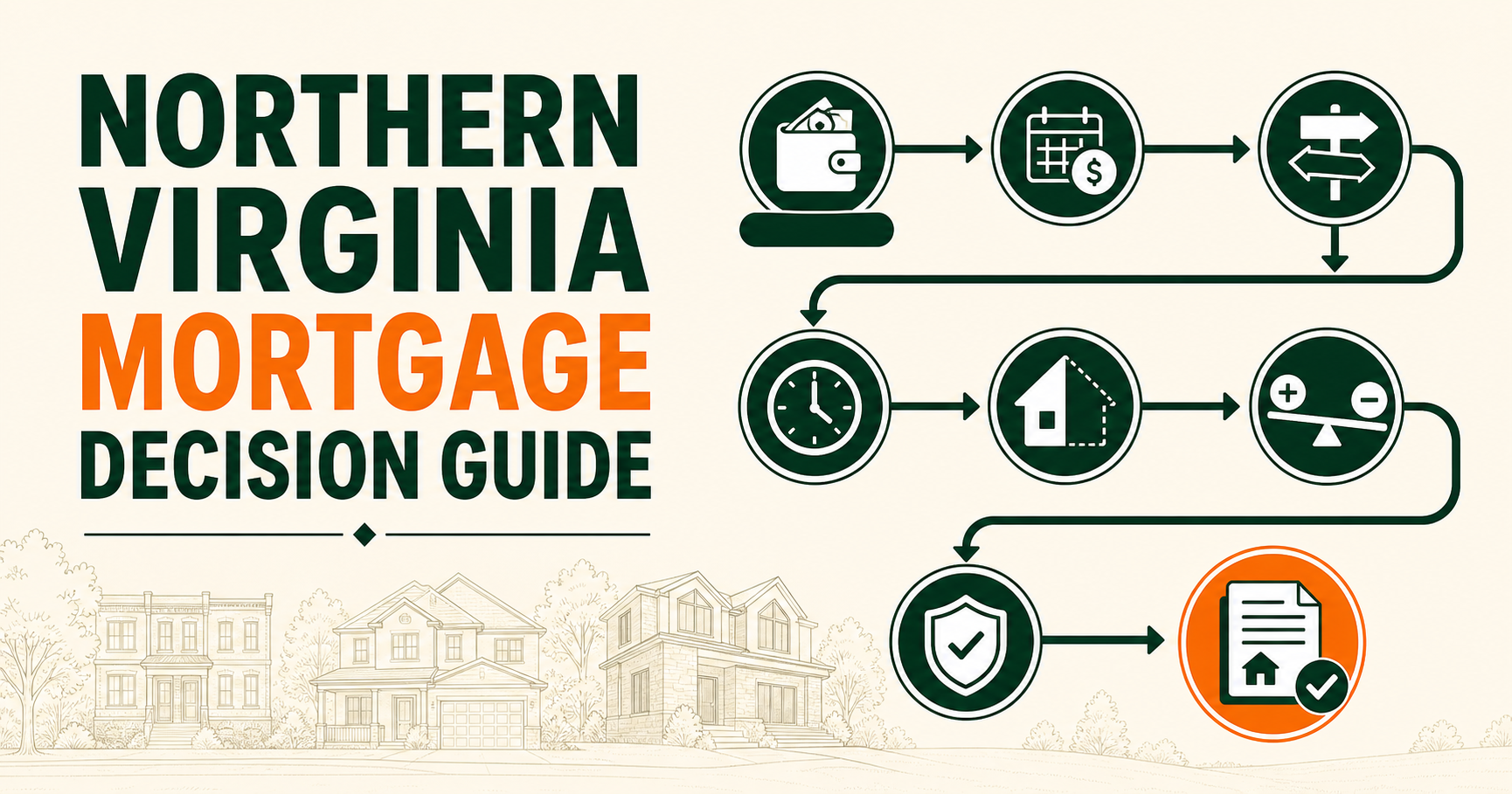
Start with your question
You do not have to begin at the beginning.
Choose the sentence that sounds most like the decision you are making today.
I am deciding how much cash to use.Start with Cash.
I am comparing conventional, FHA, or VA.Start with Program.
I am choosing a 15- or 30-year term.Start with Term.
I am comparing fixed and adjustable rates.Start with Rate.
I am comparing points or credits.Start with Pricing.
I want to understand or remove insurance.Start with Insurance.
I already have a mortgage and want to compare my options.Start with your current loan.
I have written Loan Estimates.Start with Compare.
Use the page worksheet, or download the complete four-page comparison and notes packet. Nothing is submitted to Ask A Walker.
Still deciding whether to own? Compare renting and buying first.
Does your next purchase depend on a sale? Start with the selling-and-buying cash and timing plan.
Set a comfortable housing budget
What payment and cash commitment leave room for the rest of your life?
A lender can tell you what its guidelines may allow. That is not the same as deciding what you want your housing obligation to be.
Include more than principal and interest. Taxes, insurance, mortgage insurance, association charges, utilities, maintenance, and repairs can change what ownership feels like month to month.


- Your comfortable monthly housing obligation
- The cash you are prepared to use
- The reserve you do not want to spend
- Property costs that still need verification
Use planning tools, not approval substitutes
Before you calculate: Choose a monthly boundary, cash limit, reserve goal, and realistic estimates for taxes, insurance, association charges, utilities, and maintenance.
These tools can organize assumptions; they cannot determine approval, a rate, property-specific costs, or what payment is comfortable for you.
1. Explore a comfortable home-price range2. Estimate a complete monthly mortgage payment
Bring back: Your planning range, complete-payment estimate, and the cost most likely to change.
Your output: A planning range, a payment boundary, and a list of costs that still need verification.
Choose cash and reserves
How much should go into the transaction, and what should remain available afterward?
Your down payment is only one use of cash. Keep deposits, closing costs, prepaid items, moving, property work, and post-closing reserves separate so one dollar is not silently assigned twice.
One cash plan, four separate jobs
Compare cash scenarios
Before you calculate: Hold the price and protected-reserve goal steady while you change the down payment; separately estimate deposits, closing costs, prepaids, moving, and property work.
These tools can compare entered cash assumptions; they cannot determine your final cash to close or reserve requirement.
Compare down payment and reservesAdd estimated buyer closing costs
Bring back: Two or three cash structures and the reserve you intend to protect.
Wire-fraud safeguard: Treat an unexpected change to closing or wire instructions as a fraud warning. Do not use a phone number, link, or reply address from the unexpected message. Confirm the recipient, account, amount, and procedure directly with the settlement company using contact information you previously verified through an independent source.
Does this plan depend on selling your current home? Start with the Selling and Buying cash-and-timing stage.
Your output: Two or three cash scenarios for lender verification.
Compare programs without looking for a universal winner
Which available structure supports your actual constraints?
Conventional, FHA, and VA financing can differ in eligibility, cash, insurance or funding fees, property considerations, and long-term cost. Eligibility is an option—not a conclusion.
Compare each viable program the same way
Conventional
- May offer several cash and insurance structures
- Verify complete lender terms
- Avoid universal score rules
FHA
- Review cash and qualification context
- Verify insurance and property rules
- Compare long-term cost
VA
- Confirm eligibility and entitlement
- Verify funding-fee status
- Compare other eligible structures too
Test matched program scenarios
Use only the calculator for a program you are eligible to compare.
Before you calculate: Use the same price, cash, rate date, term, property type, occupancy, and closing assumptions.
These tools can illustrate matched estimates; they cannot determine eligibility, approval, lender overlays, the offered rate, or final FHA or VA fees.
Test an FHA cash-and-payment scenarioTest a VA cash-and-funding-fee scenarioCompare FHA and conventional structures
Bring back: Viable structures and the lender questions each creates.
Relocating or working through military PCS constraints? Continue in the Relocation financing stage.
Your output: A short list of viable structures and questions for a licensed lender.
Choose a loan term
What do you gain and give up with a shorter or longer required term?
A shorter term can require a larger payment and schedule an earlier payoff. A longer term may lower the required payment while extending the schedule. Compare flexibility and your likely horizon—not only projected total interest.
Two schedules, two different required-payment commitments
- Usually higher required payment
- Faster scheduled principal reduction
- Less monthly flexibility
- Usually lower required payment
- Longer scheduled payoff
- More room for optional extra principal
Test the term tradeoff
Before you calculate: Use the same loan amount and a matched written rate assumption for each term.
This tool can compare required-payment and amortization assumptions; it cannot recommend a term or supply a rate you will receive.
Compare 15- and 30-year mortgage terms
Bring back: The mandatory-payment difference and the flexibility you value.
Your output: A term preference and the payment you are willing to make mandatory.
Compare fixed and adjustable rates
Are you accepting future uncertainty for a meaningful current benefit?
A fixed-rate mortgage keeps the note rate fixed for the loan term. It does not necessarily keep your total housing payment fixed because taxes, homeowners insurance, association charges, and mortgage insurance can still change. An adjustable-rate mortgage adds a second question: how the note rate and payment may change under the written index, margin, timing, caps, and floor.
The ARM relationship to verify in writing
Also verify the initial period, first adjustment date, later adjustment frequency, and how the lender calculated the maximum payment.
Stress-test the two structures
Before you calculate: Gather the initial rate period, index, margin, adjustment frequency, caps, floor, and maximum payment.
This tool can stress-test the terms you enter; it cannot replace the ARM disclosure, note, Loan Estimate, or lender calculation of the maximum payment.
Compare fixed-rate and adjustable-rate structures
Bring back: The stressed payment and the ownership-horizon concern you still need to resolve.
Primary guidance: CFPB on ARM index and margin and CFPB on ARM rate caps.
Your output: A preference and a list of written ARM terms to verify.
Evaluate points and lender credits
Should you pay more now, receive a credit, or choose a middle option?
The interest rate is not the entire price of the mortgage. Discount points are upfront charges tied to a lower offered rate. A rate-linked lender credit reduces some closing cost upfront in exchange for a higher offered rate. Some credits may have another stated basis, so ask the lender to identify exactly what creates the credit. Compare written options for the same loan amount, program, property type, occupancy, down payment, lock period, and estimated closing date, and test more than one reasonable time horizon.
Three pricing paths; the holding period decides what matters
Test a reasonable range—not one certain move or refinance date.
Estimate the pricing break-even
Before you calculate: Use same-day written pricing, points or credits, the monthly difference, and more than one expected holding period.
This tool estimates a break-even from written pricing inputs; it does not guarantee that you will keep the loan long enough to recover a cost.
Compare mortgage points and lender credits
Bring back: The break-even month and the assumption most likely to change.
Primary guidance: CFPB on points and lender credits.
Comparing a builder-affiliated lender incentive? Continue in the New-Construction Guide before treating the credit as savings.
Your output: A break-even horizon and matched pricing options to request.
Current owner starting point
What are you trying to change about your current loan?
Choose the question that describes your objective. These are alternatives, not a required order.
Understand mortgage insurance and program fees
What applies, and what would have to happen for it to change?
Conventional PMI, FHA mortgage insurance, and the VA funding fee are different structures. Their rules, durations, exemptions, and review processes must not be combined.
Three different lanes
Conventional PMI
Verify cancellation or termination with the controlling rule and servicer.
FHA insurance
Verify current upfront and ongoing requirements for the proposed loan.
VA funding fee
Verify eligibility, amount, and exemption status with the lender and VA sources.
For an existing conventional loan, PMI cancellation or termination may depend on whether the federal rule applies, the loan’s origination date, original value, scheduled or current principal balance, payment status and history, junior liens, valuation evidence, investor requirements, and the servicer’s written procedure. FHA mortgage insurance and the VA funding fee follow different rules.
Choose the path that matches your question
Existing conventional loan? This calculator can estimate a planning milestone; it cannot determine a legal cancellation right, the value a servicer will accept, or the servicer’s required process. Ask the servicer for the applicable written procedure before ordering an appraisal or sending a large principal payment solely to seek removal.
Estimate a conventional PMI removal milestone
Comparing a proposed FHA or VA loan? Return to Program and ask the lender to show the upfront charge, ongoing charge if any, exemption status, and duration in writing.
Bring back: The controlling rule or document, the servicer or lender procedure, and the unresolved question.
Primary guidance: CFPB on PMI cancellation and VA funding fee and closing costs.
Your output: The controlling document, question, and milestone to verify.
Current owner: Test extra principal → Buyer: Compare written options →
Test additional principal
What could an extra payment change, and what flexibility would you give up?
Additional principal can change the projected balance and payoff. Confirm how the servicer applies it, keep reserves visible, and remember that money sent to principal may not be easily available again.
Compare the loan path and the reserve path together
Keep the protected reserve outside both paths. Liquidity is part of the decision.
Project an extra-payment pattern
Before you calculate: Gather the current balance, rate, remaining term, scheduled payment, proposed extra amount, and reserve you intend to protect.
This tool projects amortization under the entered payment pattern; it cannot determine how the servicer will apply a payment or whether a loan-specific penalty or restriction applies.
Project additional mortgage principal
Bring back: The projected change and the servicing instruction you must verify.
Your output: One scenario and the servicing instructions to verify before acting.
Decide whether refinancing solves a defined problem
What are you trying to change, and how long would recovery take?
Name the objective first: payment, term, rate structure, insurance, cash flow, or equity. Compare cost, new principal, new term, cash, and break-even. Do not rely on a one-percentage-point rule.
Cash flow and net cost are different questions
A lower monthly payment can improve cash flow immediately. Under this break-even comparison, the refinance does not produce net cost savings until the cumulative monthly difference exceeds the refinance costs. Also compare the new balance and term with the remaining schedule on the current loan.
Estimate the break-even
Before you calculate: Gather the current balance, remaining term, current payment, proposed costs, new term, and expected move date.
This tool estimates one break-even scenario; it cannot determine approval, tax treatment, suitability, final costs, or whether refinancing is available on acceptable terms.
Estimate a mortgage refinance break-even
Bring back: The defined objective, estimated recovery horizon, and the assumption most likely to change.
Your output: A defined objective, estimated break-even, and matched written proposals.
Compare written Loan Estimates
Are the offers based on the same scenario, and what is actually different?
Confirm the program, term, loan amount, property assumptions, lock status, lock period, and closing date before comparing totals. Compare lender-controlled charges and lender credits separately from taxes, insurance, prepaid items, and other third-party estimates, then compare the complete projected payment and cash to close. A lower tax or insurance estimate does not by itself make one lender’s loan a better deal.
Protect your financial information. Use redacted notes from each Loan Estimate. Do not upload or email unredacted loan documents, account numbers, Social Security numbers, income records, bank documents, or wire instructions through this page.
Your blank Loan Estimate comparison worksheet
| Item | Option A | Option B | Question |
|---|---|---|---|
| Program and term | Are these the same structure? | ||
| Loan amount and cash assumption | Are the down payment and financed amount matched? | ||
| Rate, lock, and points or credits | Is it locked, until when, and what pricing created the rate? | ||
| Projected principal and interest | Is the required payment based on the same amount and term? | ||
| Insurance or program fee | What applies, how is it paid, and how long may it continue? | ||
| Complete estimated monthly payment | Which taxes, insurance, escrow, and association assumptions are included? | ||
| Origination and other loan costs | Which lender-controlled charges differ and why? | ||
| Third-party services | Which services may be shopped, and are estimates matched? | ||
| Cash to close | Which deposits, credits, prepaids, and seller or builder items are included? | ||
| ARM terms, if applicable | What are the index, margin, adjustment dates, caps, floor, and maximum payment? | ||
| Early-payment and servicing terms | Do the documents show a prepayment penalty or other term to clarify? | ||
| Unanswered questions | Who controls each answer? |
Use the CFPB Loan Estimate explainer and CFPB comparison guidance.
Have you identified a property-, offer-, appraisal-, settlement-, or timeline-related question? Review the real-estate implications with Abraham. Your lender remains responsible for loan terms, pricing, approval, and disclosures.
Download the complete four-page worksheet and notes PDF
- Comfortable budget and costs to verify
- Cash structure and protected reserve
- Viable programs and lender questions
- Term and mandatory-payment boundary
- Rate structure and stress test
- Points or credits and break-even horizon
- Insurance or program-fee rule
- Extra-principal scenario and reserve effect
- Refinance objective and recovery horizon
- Material Loan Estimate differences and who controls each answer
Print or save this blank checklist. Nothing is submitted to Ask A Walker.
Your output: A short list of material differences and unanswered questions.
Continue in the journey that owns the decision
Use the right guide for the next question.
Buying a home
Continue with the search, offer, inspection, appraisal, and settlement sequence.
Selling and buying
Coordinate equity, cash, obligations, timing, and two connected settlements.
Relocating
Connect the financing decision to the move, commute, tour, temporary housing, and timing plan.
Buying new construction
Compare builder pricing, incentives, deposits, appraisal risk, affiliated-lender terms, and construction timing before treating an incentive as savings.
Book a 30-minute real-estate planning review
Meet with Abraham at the Alexandria office to identify how your financing question may affect the property, offer, appraisal, settlement, move timing, or broader real-estate plan. Your lender remains responsible for loan terms, pricing, approval, and disclosures.
Sources, limits, and disclosures
Primary resources used for this guide
CFPB Loan Estimate; CFPB comparison guidance; CFPB ARM index and margin; CFPB ARM caps; CFPB points and lender credits; CFPB PMI cancellation; HUD Handbook 4000.1; VA eligibility; VA funding fee and closing costs; Freddie Mac comparison worksheet.
Educational and professional-review limits
This guide and its calculators are educational planning tools. They are not loan offers, approvals, rate locks, financial advice, legal advice, tax advice, or servicing instructions. Abraham Walker and Ask A Walker provide real-estate education and brokerage services; they do not originate, underwrite, approve, or service mortgages.
Privacy and relationship disclosure
Do not send Social Security numbers, bank credentials, full account numbers, tax returns, unredacted loan documents, or wire instructions through an ordinary form or email. Using this guide or having an initial conversation does not automatically create a brokerage, agency, lending, financial-advisory, legal, tax, or servicing relationship.
Information reviewed August 26, 2026. Rules, fees, program terms, benefits, lender requirements, links, and real-estate practices can change. Confirm material details with the controlling source before acting.
