
THE ALMOST EMPTY NEST
Our oldest son graduated from Hayfield Secondary School this year and is getting ready to start at Northern Virginia Community College .
Like a lot of young adults in Northern Virginia, going to college does not mean moving away from home.
He will still be living with us. He will commute to class, work part time, spend time with his friends, drive one of our vehicles, and gradually take on more responsibility for his own life.
If your child is making a similar transition, you may already know how strange this stage can feel.
Your child is legally an adult.
They may have graduated from high school. They may have a job. They may drive themselves around. They are increasingly making decisions without asking your permission first.
But they may also still be sleeping in the same bedroom, eating from the same kitchen, parking in your driveway, and relying on you in ways that did not disappear on their 18th birthday.
So what exactly is supposed to change?
That question came into focus for us during a conversation about something very ordinary.
Curfew.
We Asked Our Son What He Thought His Curfew Should Be
His answer was 1:00 AM.
At first, 1:00 AM did not sound completely outrageous for an 18-year-old.
Then we started looking at his actual schedule.
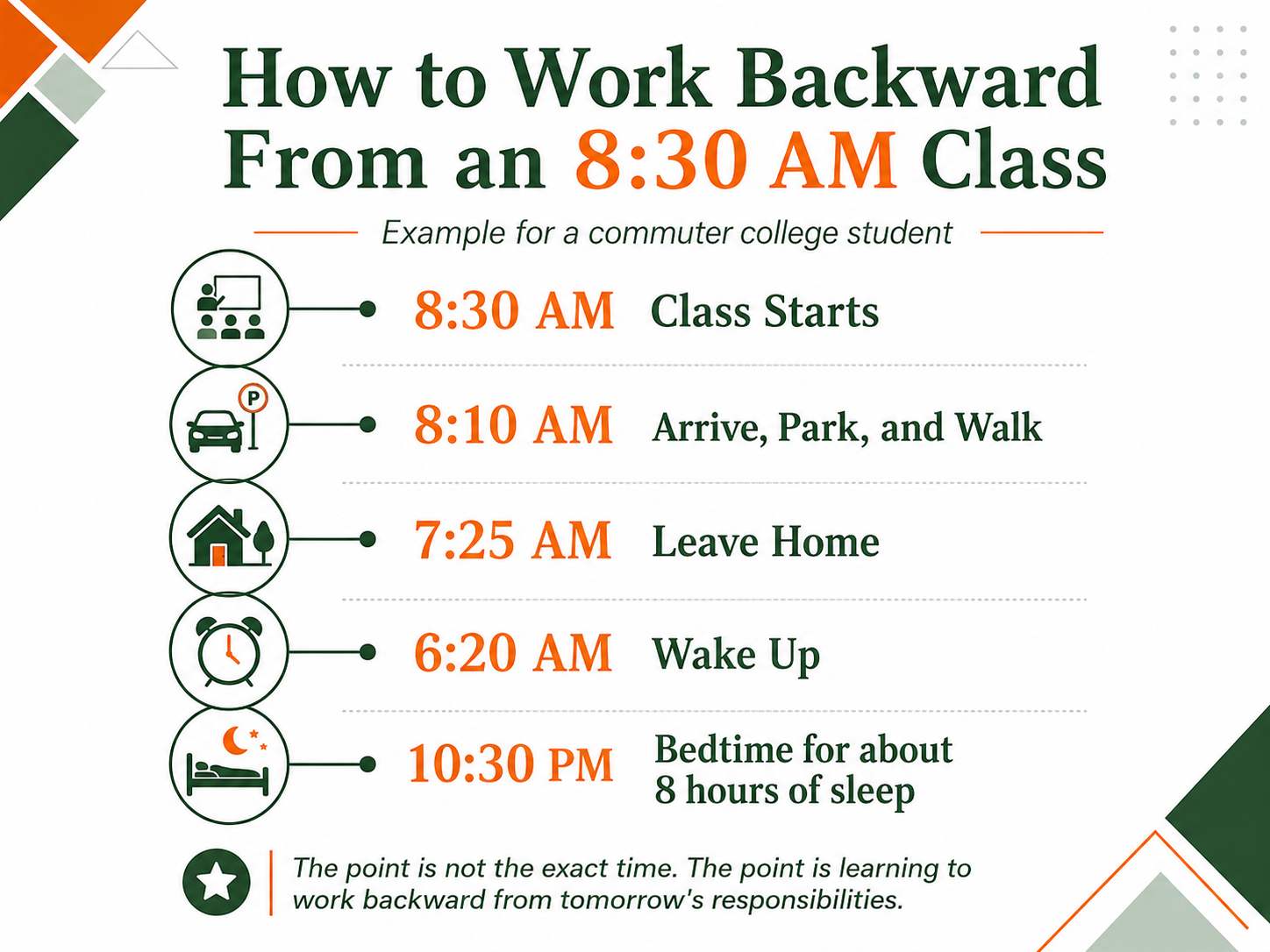
He has an 8:30 AM class at Northern Virginia Community College. The drive can take around 45 minutes. Then he has to park, walk across campus, and be sitting in class when it starts.
If you live in Northern Virginia, you probably already know that a 45-minute drive does not necessarily mean leaving 45 minutes before you need to arrive.
Traffic gets a vote.
Parking gets a vote.
And if you are commuting to college instead of walking across campus from a dorm, your morning begins long before the professor starts teaching.
NOVA has its own student parking system and designated parking requirements, which is one more thing a commuter student has to account for. You can review the college's current parking information here .
So we started working backward.
- What time do you need to be sitting in class?
- What time should you arrive on campus?
- What time do you need to leave home?
- What time do you need to wake up?
- How much time do you need to shower, get dressed, gather what you need, eat something, and prepare yourself for the day?
Eventually we arrived at the question that seemed to be missing from the calculation:
What time do you need to be asleep?
That is where 1:00 AM stopped making much sense.
Then Breakfast Became Negotiable
When we pointed out that there did not seem to be enough time between getting home at 1:00 AM and being prepared for an 8:30 AM class, our son started looking for places to save time.
One solution was simple.
He would skip breakfast.
So we asked another question.
When are you going to eat?
He had not really thought about that yet.
That exchange helped me realize that we were not actually arguing about whether 1:00 AM was an acceptable curfew.
We were talking about how you allocate a finite amount of time.
There are only so many hours in a day.
- School gets some.
- Work gets some.
- Friends get some.
- Driving gets some.
- Studying gets some.
- Eating gets some.
- Getting ready gets some.
- And sleep gets some too.
You cannot build your entire schedule around everything you want to do and then leave the necessities to whatever time happens to remain.
Eventually, the math stops working.
Sleep Is Not Whatever Time Is Left Over
Our son is 18, which puts him right at the end of the adolescent sleep recommendations.
The American Academy of Sleep Medicine recommends that teenagers ages 13 through 18 regularly get 8 to 10 hours of sleep per 24 hours. Regularly sleeping less than the recommended amount is associated with problems involving attention, behavior, and learning.
The Centers for Disease Control and Prevention similarly says adequate sleep helps students stay focused, improves concentration, and supports academic performance.
That matters because there are two very different questions a young adult can ask.
What is the least amount of sleep I can get and still wake up?
Or:
How much sleep gives me the best chance of performing the way I say I want to perform tomorrow?
Those are different standards.
If you want strong grades, want to retain what you are learning, want to be alert in class, and are also balancing a job and a social life, sleep is not an inconvenience stealing hours from everything else.
Sleep is part of what makes those other hours useful.
College Requires More Freedom and More Self-Management
One thing I found particularly interesting is that Northern Virginia Community College itself treats time management as an important college-success skill.
NOVA's College Success Skills course includes academic planning, financial literacy, goal setting, stress management, critical thinking, and time management.
NOVA's Alexandria Academic Success Center also provides support with study skills and time management. You can learn more through the NOVA Academic Success Center .
That seems especially relevant for a commuter student.
Our son recently left a much more structured environment at Hayfield Secondary School, where the school day begins at 8:00 AM.
High school supplied a lot of structure automatically.
College provides more freedom.
But that freedom increasingly requires you to build the structure yourself.
Maybe that is the real transition.
It is not simply going from:
I have a curfew.
to:
I am 18, so I do not have a curfew.
It is going from:
Other people manage enough of my schedule that I can function.
to:
I know how to manage my own schedule well enough that nobody needs to do it for me.
That is a much bigger step.
The Car Changed the Conversation for Us
There is another factor in our situation.
Our son recently started driving independently, and the vehicle he is using belongs to us.
That changes how I think about allowing natural consequences to teach the lesson.
The National Highway Traffic Safety Administration identifies drivers ages 17 through 23 as being among those at higher risk for crashes caused by drowsy driving. NHTSA also says drowsiness affects alertness, attention, reaction time, judgment, and decision-making.
NHTSA's drowsy-driving guidance identifies midnight through 6:00 AM as one of the peak periods for sleepiness and advises teenagers to delay driving until they are well rested.
There is even a Northern Virginia connection.
NHTSA cites research from Fairfax County that found a reduction in crashes involving 16 to 18-year-old drivers after high school start times were delayed by 50 minutes. You can read more about that research through NHTSA's discussion of school start times and drowsy driving .
That does not mean staying out late automatically makes a young driver unsafe.
But it reinforces something that matters to me as a parent:
Sleep and young-driver safety are connected.
And that creates a line between consequences I am comfortable letting our son experience and consequences I am not interested in experimenting with.
If you stay out too late and feel terrible in class the next morning, maybe you learn something.
If you fail to plan when you are going to eat and end up hungry between classes, you will probably plan differently next time.
If you underestimate how much time parking and walking to class will take and arrive late, that lesson may be more memorable than another conversation with your parents.
But driving significantly sleep deprived in a vehicle we own is different.
I do not feel obligated to let that lesson play itself out.
Maybe He Eventually Has No Curfew, but Our Car Still Has Conditions
This distinction has become increasingly useful to me.
Our son is 18.
He should have more control over his own life.
If he decides that staying out late is worth being tired the following day, there is a reasonable argument that adulthood increasingly means making that decision for himself.
But using our vehicle is a different question.
Our position is becoming something closer to this:
If you choose to stay out so late that you cannot reasonably get enough sleep before driving the next morning, you may need another transportation plan.
That might mean public transportation.
Of course, public transportation could make the morning routine even longer.
That is part of the tradeoff.
The important distinction for me is that this is not:
You stayed out late, so Dad is taking the car away as punishment.
It is:
You made one choice that affects whether another choice is still safe and reasonable.
That feels much closer to the kind of cause-and-effect thinking we want him to develop.
So I Asked Other Parents
This is our first time parenting an 18-year-old.
We have years of experience being adults. We have exactly one attempt at raising this particular 18-year-old.
So I wanted to know how other parents were handling the same transition.
I asked parents on Reddit.
I also asked parents here in Northern Virginia on Nextdoor.
The answers were all over the place when it came to an actual time.
- Some parents had no curfew.
- Some used midnight.
- Some used 1:00 AM.
- Others maintained earlier household rules even with adult children.
But underneath those differences, there was considerably more agreement than I expected.
The same ideas appeared repeatedly:
- Communication.
- Responsibility.
- Respect for everyone else in the household.
- Meeting school and work obligations.
- Increasing freedom as a young adult demonstrates the ability to manage it.
One parent explained that their children did not really have curfews even in high school. Instead, the expectation was that they manage their responsibilities, including getting themselves to bed early enough to be prepared for school.
Another described a household without traditional curfews but with clear expectations. Their children still had to communicate, wake up when expected, and remain functional for their responsibilities.
That is probably much closer to where I eventually want us to be.
Then Another Parent Challenged My Thinking
One of the strongest arguments against simply imposing a curfew made me reconsider my own role in the process.
If I look at my son's class schedule, commute, work schedule, and sleep requirements and then calculate exactly what time he needs to come home every night, have I really solved the problem?
Or have I simply continued managing it for him?
Because I do not want my son to be 20 years old asking me:
What time should I come home tonight?
I want him to look at tomorrow and work backward.
- I have class at 8:30.
- I need to leave around 7:00.
- I need time to get ready.
- I want enough sleep to perform well.
- Therefore tonight needs to end at a certain time.
At some point, the person telling him no needs to become him.
That may be the strongest argument against a permanent curfew.
The goal is not to become really good at setting our son's curfew.
The goal is to make the curfew unnecessary.
But His Friends Do Not Have Curfews
Our son knows other students going to NOVA who apparently do not have curfews.
Naturally, this entered the negotiations.
I actually encourage him to talk to his friends about these things.
I jokingly call them his band of brothers from other mothers.
I want him to hear how they are approaching school, jobs, cars, money, relationships, and all of the other adult decisions they are beginning to encounter.
There is value in collective thinking.
But there is another skill that needs to develop alongside it:
Learning how much weight to give different advice.
A friend saying, "I don't have a curfew," tells you something about the rules in that friend's household.
It does not tell you whether that friend gets enough sleep.
It does not tell you how consistently that friend attends class.
It does not tell you what grades that friend is trying to earn.
It does not tell you whether that friend works.
It does not tell you how long that friend's commute is.
And it does not tell you whether that friend has demonstrated an ability to regulate their own schedule.
Those are different data points.
So I found myself asking our son a different question:
Are the people whose system you want to copy getting the results you want?
That seems like a useful question far beyond curfews.
Your Family Does Not Have to Copy Someone Else's
One Northern Virginia parent responding to my Nextdoor post expressed an idea I particularly liked.
What happens in another family can be right for them without automatically being right for yours.
Your 18-year-old may already manage school, sleep, work, transportation, money, and household responsibilities without you ever having to intervene.
If so, telling them to be home at midnight simply because they are 18 may accomplish very little.
Another 18-year-old may still need more external structure.
And that structure may decrease quickly as they demonstrate more responsibility.
The rules in either household tell you very little about what should happen in yours.
The more useful question is about demonstrated capability.
Maybe the Question Is Not Whether an 18-Year-Old Should Have a Curfew
I think the better question may be:
Has my young adult demonstrated enough self-management that a curfew is no longer necessary?
Age alone cannot answer that.
Behavior can.
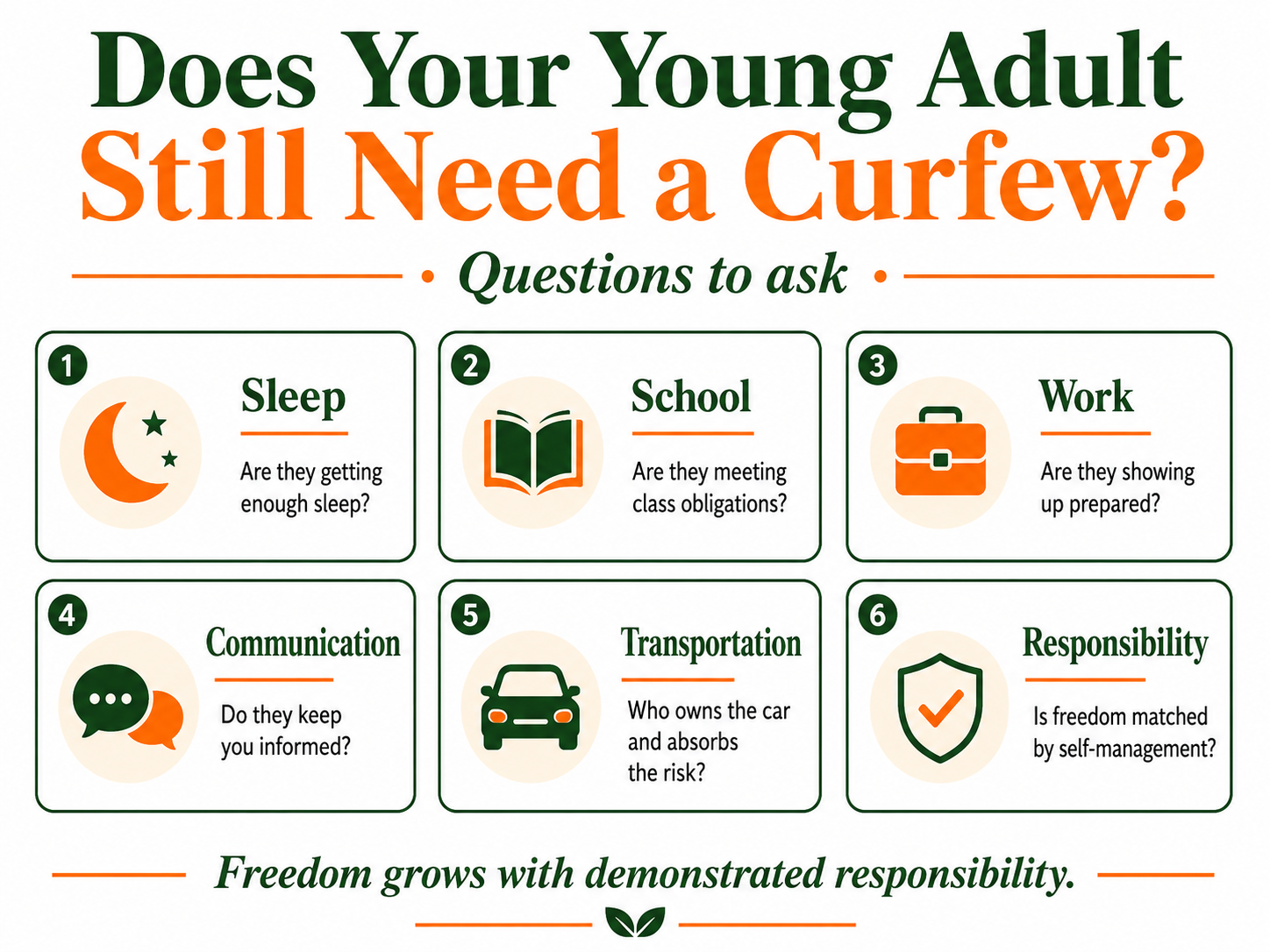
If you are working through this transition in your own home, these are some of the questions I think are worth asking:
- Are they consistently meeting their school and work obligations?
- Are they getting enough sleep without someone else managing bedtime?
- Can they work backward from tomorrow's responsibilities and plan tonight accordingly?
- Do they communicate when plans change?
- Do they respect the other people living in the household?
- Can they manage meals, transportation, assignments, work schedules, and other basic responsibilities?
- Are they using a vehicle or another significant resource that you still own or pay for?
- When they make a poor decision, who actually absorbs the consequence?
- Are they asking for more freedom while also taking on more responsibility?
- Is the level of freedom they have producing the outcomes they say they want?
Those questions seem much more useful to me than arguing over whether midnight, 1:00 AM, or 2:00 AM is the universally correct answer.
The Empty Nest May Start Before the Bedroom Is Empty
Before going through this, I tended to think of becoming an empty nester as an event.
Your child moves out.
The bedroom becomes empty.
The house gets quieter.
Then you figure out what comes next.
I am starting to think the transition begins much earlier.
Our son is still living at home.
His bedroom is occupied.
There is still a car for him in our driveway.
He is starting college locally instead of moving into a dorm.
But our role as parents is already changing.
We are gradually moving from making decisions for him to watching him make more decisions for himself.
Sometimes that means allowing natural consequences to teach lessons we used to teach directly.
Sometimes it means recognizing that a particular consequence involves enough risk that we are still going to put a boundary around it.
And sometimes it means acknowledging that what worked when he was 16 may not be appropriate when he is 18, 19, or 20.
If your child has recently graduated from high school and you are somewhere in this same in-between stage, you may be discovering it too.
The house is not empty yet.
But parenting is already changing.
Our children are learning how to manage adulthood.
And somewhere along the way, we have to learn how to stop managing every part of it for them.
Check out this article next